
Building self-care and better relationships through a person-centred lens.
I find reflecting upon my work of huge value and importance. The workshop below was piloted with colleagues at Loughborough University, and is available to other organisations that wish to build and develop their own wellbeing strategies, understanding of the Person Centred Approach and its relevance in different contexts, and to empower their workforce with skills to manage their relationships with themselves and colleagues.
I find the concept of “wellbeing” in the UK a troublingly mixed blessing. Research has suggested that people working for companies that invest in understanding the wellbeing needs of their workforce and adopt holistic wellbeing programmes experience better outcomes for themselves, and their employers see improvements such as a fall in absenteeism and recruitment costs. However, workplace wellbeing programmes can also be superficial, ineffective “box-ticking” exercises (which I myself have experienced) or shifting responsibility onto employees themselves instead of addressing workplace issues (which I have also experienced).
Back in October 2024, I piloted a one-hour workshop at Loughborough University, designed to give attendees some basic understanding of some core theoretical concepts within Carl Rogers’ Person Centred Approach (PCA). Armed with some understanding of these concepts, my hope was that attendees would be more able to reflect on their own experiences and emotions, empathically understand those around them, and extend a less judgemental olive branch to both themselves and others, all with the aim of improving wellbeing.
Check-In
The process of check-in (or out) is a reflective and self-empathic practice of immediacy whereby a person asks themselves how they are truly feeling at that moment in time. It invites us to connect with our emotional state, and empathise with our own feelings and behaviours associated to that emotional state. As well being able to choose to extend grace and kindness to ourselves, it also invites us to consider the tasks we are currently engaged in and what we have the capacity to give to them. Check-in can also be empathic to those around us – if we are in a particular emotional state, are we in a position to give enough to the task in hand or those around us? It gives us an opportunity to contract (or re-contract) and negotiate with others based on our own needs.
In counselling, check-in is an important exercise in self-awareness, congruence, empathic understanding and Unconditional Positive Regard (UPR) under the principle of immediacy, both with ourselves (the counsellor) and with our clients. We could ask ourselves the question “how can I show up for the client if I can’t show up for myself?”. Check-in allows us to centre ourselves in the moment, address anything that cannot wait, put aside things that can, and show up for the relationships we are in.
Attendees were invited to reflect on their current state and, led by myself, offer this verbally to the group if they felt comfortable to do so.
The Core Conditions
As a nearly-qualified Level 4 counsellor, the above grouping of three of the six Rogerian “Six Necessary and Sufficient Conditions of Therapeutic Personality Change” (a mouthful on the best of days!) can elicit a shudder. In the Person Centred Approach, each of the six is, as the title suggests, “necessary”, so the concept of there being “core” conditions, or “facilitative conditions” in some literature, feels minimising and dismissive. However, for the purposes of this workshop, I wanted to ensure that attendees weren’t swamped with the depth of theory that might detract from the purpose. So I swallowed the bitter pill.
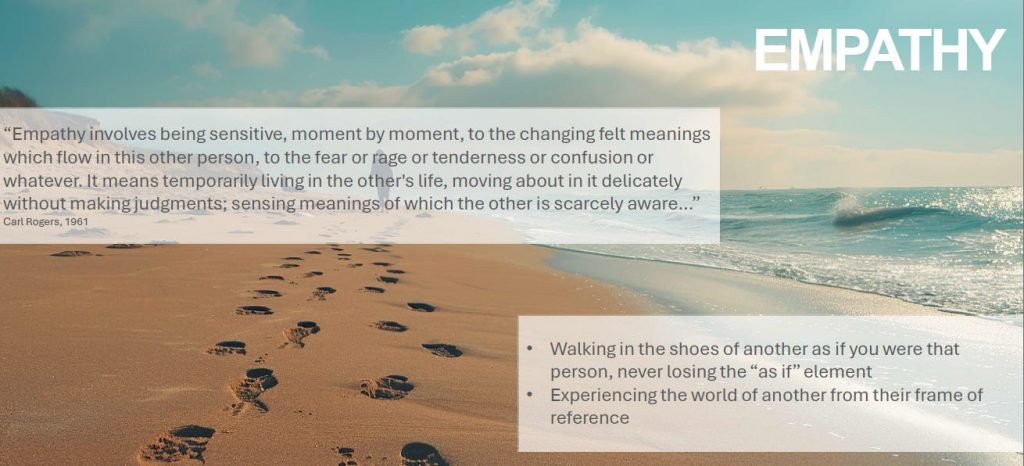
Inviting attendees to explore these core conditions of congruence, empathy and UPR allowed the possibility of them to connect with the trueness and authenticity of their own identity, understand themselves and others more, and extend a reduced judgemental approach to their relationships. The aim of this was to not only foster better working relationships by considering the perspective of those the attendees were in relation with, but to foster that better relationship with themselves also. Self empathic understanding and unconditional self positive regard can be argued as underpinning practices to striving for increased congruence, a more authentic experience of our world and ourselves.
Active listening
This is more of a counselling practice than a PCA concept, but an important one to consider when in relation with others. In this context, being able to actively listen invites people to have deeper, more meaningful conversations.
In the workshop, attendees were tasked with pairing-up and talking to one another about some aspect of their week (one that both the talker and the listener felt comfortable and “safe” in sharing). The talkers spoke to their listeners, and their listeners were tasked with only listening, offering no verbal feedback. After the exercise, invitations were extended to both parties to feed back on their experiences. Listeners were asked what it was like to offer no verbal feedback, how this affected their own authenticity (congruence), how deeply they felt they empathised with their talker, and whether they were able to experience UPR for them. Talkers were invited to consider whether they perceived these core conditions from their listener through non-verbal cues.
Phenomenology
Whilst the Person Centred Approach does not explicitly list “phenomenology” as a concept, Rogers does refer to the “phenomenological field” and subjective lived experiences as “The portion of experience of which the individual is aware. It is this subjective world, the phenomenal field, that is the basis of behavior” (1951). In a nutshell, Rogers posits that there is no objective reality, we all have our own perception of reality based on our experiences and interpretations.
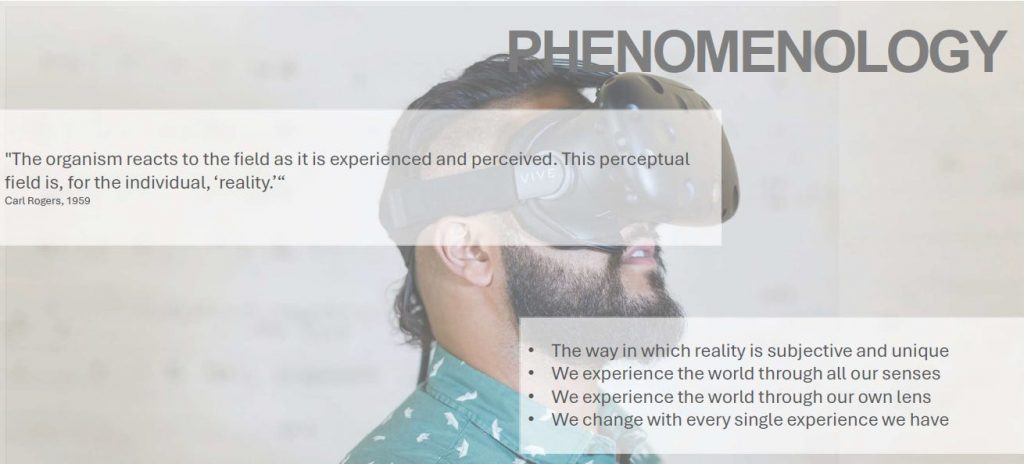
Bringing together the work previously explored with attendees, we examined the concepts of the self-structure and self-concept, introjected values and conditions of worth, and explored what incongruence looks and feels like as a result of ourselves experiencing the world around us. Attendees, who all knew me to a greater or lesser extent (given we all worked in the same department), were asked to individually and privately consider and complete the following sentence based on their own unique experience of me:
“Steve walked into the room and saw something that made him stop in his tracks. He couldn’t believe his eyes…”
Attendees were then invited (not mandated, which is important for safety and congruence in this exercise) to share their finished stories. The responses were wildly different (and some were hilarious):
“… someone had filled all the tables with delicious hot breakfast. There was a ransom note on the table: “You must break your fast in order to escape! Somewhere hidden in the food is the key to your survival!””
“… the entire digital staff files had been deleted”
“… everyone was speaking openly and honestly about their authentic self”
These sentences were an amusing and light-hearted way of me, as facilitator, being able to receive, reflect on and offer back context to the group of how each individual offering me their story was based on the ways in which they had experienced me during our varying relationships with each other. This activity wouldn’t work in exactly the same way in the context of attendees not knowing very much about me at all, but it can be effectively adapted to other contexts.
Check-Out
As the workshop drew to a close, I felt it was important to practice what we had been considering throughout. So, we practiced a check-out in the same way we performed check-in.
Feedback
Attendees were invited to anonymously complete an online feedback form in their own time. Feedback was overwhelmingly affirming, with developmental feedback offered around timings – they wanted more time to explore and discuss the concepts they’d been introduced to! So, the workshop has been extended from one hour to two-and-a-half hours, and will be offered over four sessions from May to September for Loughborough University’s Human Resources team in 2025. Some of the feedback is included below:
Overall satisfaction with the workshop…
100% of respondents gave a score of 4 or 5 out of 5 (average 4.7).
The workshop was well planned, organised and facilitated…
100% of respondents gave a score of 5 out of 5.
I feel the workshop…
Will help me in my job…
100% of respondents said “A lot” or “A good amount”.
Will help me in my personal life…
100% of respondents said “A lot” or “A good amount”.
Made effective links to Doing it Differently…
86% of respondents said “A lot” or “A good amount”, with 14% saying “Somewhat”.
Met my expectations…
100% of respondents said they “Strongly agree” or “Agree”.
Was relevant to me…
100% of respondents said they “Strongly agree” or “Agree”.
Set an inclusive tone…
100% of respondents said they “Strongly agree” or “Agree”.
Balanced listening with participation…
86% of respondents said they “Strongly agree” or “Agree”, with 14% saying “Disagree”.
Kept me safe whilst inviting my participation…
100% of respondents said they “Strongly agree” or “Agree”.
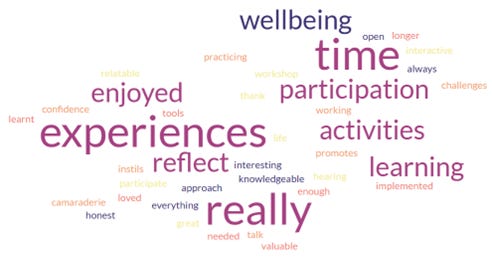
One thing I particularly enjoyed is…
One thing I’d suggest for future sessions is…
· A bit longer
· I wish it was longer
· I think it 1.5 hours would be good to allow more time for discussion.
· Maybe a slightly longer session in order to fully explore the themes and discuss practical ways to implement the theories and tools in everyday life within different types of relationships.
· Longer time. The participation and the talking to others after the activities.
· Having more time for the session to enable feedback on all activities and ask questions.
Additional feedback…
· It was fab 🙂
· During the session Steve successfully created an environment which felt safe to share personal stories 🙂
· Loved the session, and thought Steve facilitated perfectly. We talk a lot about wellbeing in HR and I thought something like this for me, adds so much more than the other 20 min sessions where you are just told to smile etc. Which definitely has its place, for that quick fire moment, but for more development and long-term wellbeing at work, I think this is much more valuable.
· Thank you giving your time to plan, prepare and deliver the session.

Leave a Reply